


Physical Therapists Beat a PT App

Lately, digital health apps have completely changed how some people handle aches, sports injuries, and recovery. Programs like Hinge Health or Sword Health promise that you can bounce back from an injury right from your living room using automated video exercises. Insurance companies are even offering these to try to replace in-person visits with your physical therapist. Some employers have added these and reduced your therapy benefit.
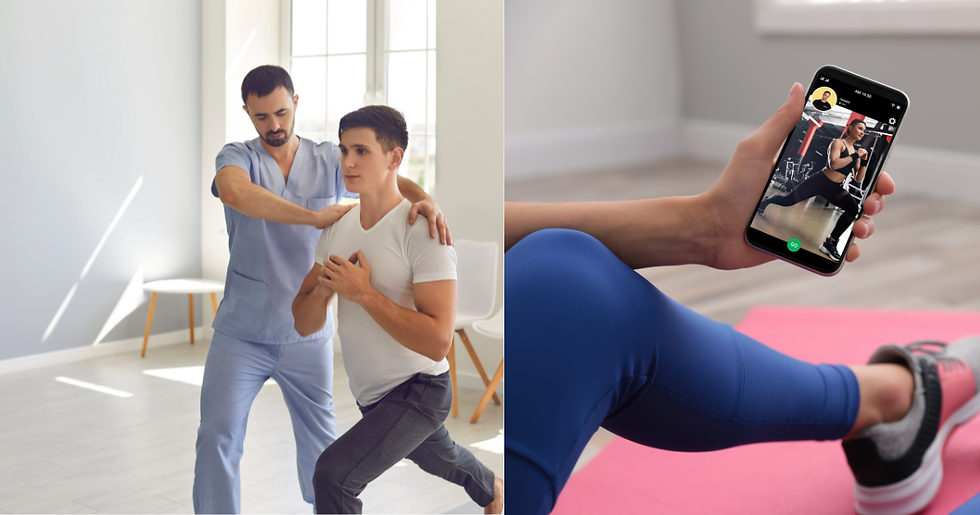
For some people, it’s a convenient starting point. But for a lot of others, the exercises just don’t seem to get them across the finish line. If you've been diligently doing your app workouts and are still not better, you are definitely not alone—and it is not your fault.
Now, many of these digital programs do offer video calls with a licensed physical therapist. While having a professional to talk to on a screen is a huge step up from just watching a generic video, a video chat still isn't the same as an in-person visit. A screen acts as a barrier, leaving out the single most powerful tool in injury recovery: hands-on care. Moving your body is incredibly important to heal, but a video check-in usually isn't enough on its own. Here is why an app can only take you so far, and why an in-person visit makes such a massive difference.
First, a camera can’t see the sneaky ways your body cheats to protect an injury. When a muscle or joint hurts, your body naturally shifts its weight or changes how it moves to avoid discomfort. Even the most eagle-eyed therapist on a video call can't see every angle or catch those subtle shifts. Without a physical therapist in the room to spot those compensations and gently guide your body back into alignment, you might accidentally overload the wrong muscles. This can end up delaying your recovery or even causing a new ache somewhere else.
On top of that, recovering from an injury often involves stiff joints or tight tissue that independent stretching just can't unlock. An app simply can't feel where your movement is blocked. This is where hands-on therapy—like joint mobilization and targeted massage—becomes a game-changer.

When a therapist uses hands-on techniques, it does a lot more than just feel good. It helps safely increase your range of motion and calms down guarding muscles. This hands-on work creates a temporary window of relief, making it much easier and more comfortable for you to do the actual exercises you need to rebuild your strength.
Plus, human touch gives us instant feedback that a webcam just can't replicate. When we place our hands on a recovering joint or muscle, we can feel exactly how tense the tissue is, how much swelling is hiding underneath, and how the joint actually moves. That kind of real-time, physical feedback allows us to adjust your treatment on the spot.
At the end of the day, the best path to recovery is a team effort between hands-on treatment and active exercise. Hands-on care clears the path by easing pain and loosening tight areas, while exercise builds the long-term strength to get you back to 100%. Video calls and apps are great tools, but they can't replace the personalized, physical partnership you get in a clinic. If you’ve hit a wall with your app, your body might just be asking for that human touch to finally unlock a full recovery.
___________________________________________________________________________________________
Christopher DiPasquale, PT, DPT, PhD, OCS, SCS, COMT, CHT is a physical therapist at Performance Physical Therapy & Sports Medicine, with offices in Hebron and Colchester, Connecticut. He is board certified by the American Board of Physical Therapy Specialties in Orthopedic Physical Therapy and Sports Physical Therapy, a Certified Hand Therapist by the Hand Therapy Certification Committee, and is a Certified Orthopedic Manual Therapist. Visit pptsm.com for more information.


Comments